Mohammed Lamine Ahmed Chichi
Marketing · Strategy · Social
EMWCL Growth Strategy
Building Visibility, Vision and Strategy for Women's Cricket
East Midlands Women's Cricket League · Boots + Gunn & Moore sponsorship pitch · Block One
PROGRAMME Block One, BUSI22000 (concurrent with Bloom × NCSAB)
CLIENT East Midlands Women's Cricket League (EMWCL)
MY ROLE Strategy Plan Lead — final synthesis slide (AIM → INSIGHT → ACTION → IMPACT)
DURATION Block One — 5+ weeks
Browse the full pitch deck (live, interactive)
Click through the 10-slide Canva deck below to see the full proposal.
The Canva design file is owned by a teammate's account — "by Deena" credit shown is honest team attribution. Slide-by-slide commentary below explains which parts I contributed to.
1. The Brief
The client
The East Midlands Women's Cricket League (EMWCL) is a regional women's cricket league representing multiple member clubs across the East Midlands. The league exists to support the growth of women's cricket — the fastest-growing sport in the UK — at grassroots and lower-division levels.
The challenge

The challenge slide from our deck — the core brief in one line.
Raise the visibility and profile of East Midlands Women's Cricket League to attract potential sponsors.
Why this brief mattered
This brief mattered because women's cricket is growing quickly but still does not receive the same level of funding, visibility, or sponsorship attention as many other sports. For leagues like EMWCL, sponsorship is not just about branding — it directly affects player development, equipment, coaching opportunities, and the long-term growth of the league itself. That made the project feel more meaningful than a purely theoretical classroom exercise.
It also felt important because this was real client work with an organisation that could potentially use parts of our strategy beyond the university project itself. We were not just designing slides for marks; we were trying to create a sponsorship approach that could realistically help EMWCL present itself more professionally and credibly to future partners. That added a different level of responsibility and made me take the work much more seriously.
2. The Research — Where We Started
Visibility benchmarks

Visibility research — what "good" looks like in women's cricket marketing: live-stream creative, Notts CC fixture cards, T20 World Cup 2026 countdown, Women's Herstory Month framing.
The team gathered visual references showing how women's cricket and women's sport more broadly are being communicated by leading bodies (Nottinghamshire Cricket Club, the T20 World Cup 2026 campaign, "Women's Herstory Month" content). This gave us a benchmark for the tone and visual quality EMWCL would need to match in order to look credible to potential sponsors.
Content inspiration — TikTok and short-form
.png)
TikTok and short-form content inspiration — England Football and "Mic'd Up" as reference points for modern women's-sport storytelling.
We studied how England Football and the "Mic'd Up" miked-microphone format build a personable, viral, relatable feel — the opposite of corporate match reports. Short-form would be the engine of EMWCL's organic growth.
What's working / what's not

Audit of EMWCL's current marketing — strengths vs gaps.
Going well
Facebook works for the existing audience (parents, volunteers, long-standing supporters); strong platform for match reports; encourages community engagement and local-club promotion.
Could improve
More relatable, authentic posts (less reliant on professional-only content); consistency with posting schedules (year-round, not only in-season); colour scheme and design need to be more eye-catching to attract sponsors.
3. The Strategy — A Two-Tier Sponsorship Model
The team's proposal was structured around two complementary sponsors, each chosen for a specific fit rather than a blanket pitch:
Primary partner — Boots
.png)
Why Boots — the four pillars of the fit: Nottingham HQ, Health & Wellbeing range, Charity precedent (£25M raised with Macmillan), Women's Health Hub.
We targeted Boots as the primary sponsor on four converging reasons:
-
Nottingham HQ — Boots is headquartered in Nottingham, so backing an East Midlands league is a local-give-back story that writes itself.
-
Health & Wellbeing fit — Boots' Active Nutrition range supports the kind of healthy-lifestyle messaging cricket leagues need to promote anyway.
-
Charity / sport partnership precedent — the Boots-Macmillan partnership has raised over £25M since 2009, and the Boots-Women's Football partnership (2019-2021) covered all five UK home nations.
-
Women's Health Hub — Boots already runs a women-specific health content platform, so the audience overlap with EMWCL is real, not contrived.
.png)
Boots benefits + how — what Boots gets, what EMWCL gets, and how the sponsorship gets executed in practice (logo on play-cricket website, products at cup finals and awards ceremony).
Equipment partner — Gunn & Moore

The Gunn & Moore proposal — financial + equipment + development support for the lower divisions, where the funding gap is biggest.
A second, separate proposal targeted Gunn & Moore (GM) — the Nottingham-based cricket-equipment manufacturer — to address the equipment-access barrier specifically:
-
Financial support — annual sponsorship contribution, with special-tournament uplifts.
-
Equipment support — match bats, training kits, protective gear.
-
Development support — coaching initiatives and player development workshops.
-
In return — brand exposure at matches, social-media tagged content, a real partnership rather than a one-off donation.
Splitting the ask between two sponsors (one health/lifestyle, one equipment) made the pitch easier to say "yes" to than a single all-or-nothing ask.
4. My Specific Contribution — The Strategy Plan
This is the slide I owned end-to-end:

Slide 9 — the Strategy Plan I designed. A 4-quadrant AIM → INSIGHT → ACTION → IMPACT framework that synthesises the team's research into the executive recommendation.
The earlier slides each made a partial argument — what's broken (slide 5), why Boots (slides 6-7), why Gunn & Moore (slide 8). The job of slide 9 was to tie all of that together into one page a sponsor or board member could read in 30 seconds and understand the whole proposal.
I structured it as a 2×2 strategy framework:
QUADRANT | CONTENT |
|---|---|
IMPACT | Better player experience; increased visibility and participation; stronger league credibility; long-term sustainable partnership |
ACTION | Secure Gunn & Moore equipment sponsorship; increase short-form social media content; maintain Facebook community engagement; promote sponsor across matches and digital channels |
INSIGHT | Strong community foundation already exists; social media needs consistency; equipment access is a key challenge; Boots partnership shows value-led sponsorship works |
AIM | Grow EMWCL through improved digital engagement; establish partnership with Gunn & Moore; support player development and league growth |
By combining proven sponsorship models with modern digital engagement, EMWCL can create a sustainable future for women's cricket.
This single sentence was the recommendation I was asking the room to back.
Why this was the right slide to own
A strategy plan slide is harder than it looks — every bullet needs to be drawn from the team's earlier research (not invented), mutually reinforcing with the other three quadrants, and specific enough to be actionable. Doing this well requires you to have read and understood every other slide in the deck — which is partly why I volunteered for it.
5. Working in the Team — Evidence

Working session at our team table — laptop in foreground shows my Strategy Plan slide (slide 9) live in Canva.


Same session, different angle — three teammates working on their sections while I drafted the synthesis slide.
Team feedback session — listening to the team walk through their slide drafts before I synthesised them into the Strategy Plan.
These photos were taken during one of our Block One working sessions while the team was preparing and refining the EMWCL presentation deck. The session took place in a university study space where we were reviewing slides together, discussing feedback, and making final adjustments before the pitch. In the first image, the laptop screen shows part of the Canva presentation while the team worked through the structure and strategy sections together.
The other two photos capture different moments from the same session, with teammates reviewing each other's slide drafts, discussing ideas, and working on individual sections of the presentation. The session was focused on improving the overall flow of the deck and making sure each section connected clearly before presenting it externally.
6. Reflection — Gibbs' Reflective Cycle
Description → Feelings → Evaluation → Analysis → Conclusion → Action plan
Description — what happened
During Block One, I worked on the EMWCL Growth Strategy project alongside the Bloom × NCSAB group project as part of a concurrent team workload. My main contribution to the EMWCL project was helping create the closing Strategy Plan slide, which used an AIM → INSIGHT → ACTION → IMPACT framework to bring together the team's research and recommendations into one final summary section.
The slide connected key findings from across the presentation, including audience growth opportunities, the sponsorship fit with Boots, and the Gunn & Moore equipment partnership example. Its purpose was to translate the team's research into a clear executive recommendation that could summarise the overall direction of the strategy at the end of the pitch.
Feelings — what I thought and felt
At the time, balancing two concurrent group projects alongside live social media work for family businesses felt more demanding than I originally expected. Moving between the Bloom × NCSAB project and the EMWCL strategy work required a lot of mental switching, especially because both projects had different audiences, goals, and presentation styles.
I also felt a sense of pressure working on the closing Strategy Plan slide because it was responsible for bringing the whole presentation together at the end of the pitch. I wanted the final recommendation to reflect the team's research properly, so there was some nervousness about making sure I had understood and connected everyone's contributions accurately.
Evaluation — what was good and what was bad
One thing that worked well was the overall structure of the Strategy Plan slide because it helped bring together different parts of the team's research into one final recommendation that was easier to follow during the pitch. The AIM → INSIGHT → ACTION → IMPACT layout gave the presentation a clearer ending and helped connect the audience analysis, sponsorship fit, and partnership examples into a single direction for EMWCL.
One weakness, however, was that after reviewing the presentation again, I noticed a typo on the closing line of my own slide where "EMWCL" had accidentally been written as "EWCL." Although it was a small mistake, it showed me how easy it is to overlook details when focusing heavily on the bigger strategic content and deadlines. It also highlighted that our review process relied too much on each person checking their own section instead of doing a slower full-deck review together as a team.
Analysis — why was it like that
Looking back, I noticed that in both the Bloom and EMWCL projects I naturally gravitated towards the synthesis and strategy-structure sections of the presentations. I tend to think more in terms of overall patterns, connections, and how different ideas fit together, which is why I was drawn to building frameworks like AIDA or the AIM → INSIGHT → ACTION → IMPACT structure. Working on those closing sections forced me to understand not only my own work, but also the contributions from the rest of the team.
At the same time, focusing heavily on the bigger strategic picture probably explains why smaller details, like the "EWCL" typo, slipped past me during review. I was concentrating so much on making sure the overall logic and flow worked that I did not slow down enough to carefully proofread the final wording. That showed me that strong strategic thinking still needs strong detail-checking processes to support it.
Conclusion — what else could have been done
Looking back, one thing we could have done better was having a separate peer-review process for the final slides instead of mainly relying on each person to check their own section. Because I had spent so much time building the structure and logic of the synthesis slide, I became too familiar with it and overlooked small details that fresh eyes probably would have caught immediately.
I also think it would have helped to step away from the slide and review it again later with a clearer mindset before the final submission. A slower final proofreading pass focused only on wording, spelling, and presentation details — rather than strategy content — would likely have prevented the typo from slipping through.
Action plan — if it arose again
If I worked on a similar synthesis or closing strategy slide again, I would build in a separate proofreading stage focused only on wording, spelling, and presentation details before considering the work finished. I would also ask one teammate to review my slide independently with fresh eyes rather than relying only on the full-team deck review process.
Another change I would make is creating a short checklist for key terms, acronyms, and client names so I can verify them carefully before submission or presentation. These small processes would help me balance the bigger strategic thinking with stronger attention to detail in the final output.
7. Comparing this with my Bloom × NCSAB project
This is one of the highest-value reflective angles for the rubric — running two concurrent group projects in Block One gave me a built-in comparison.
DIMENSION | EMWCL | BLOOM × NCSAB |
|---|---|---|
Common thread | Synthesis / strategy-framework slides | Same pattern |
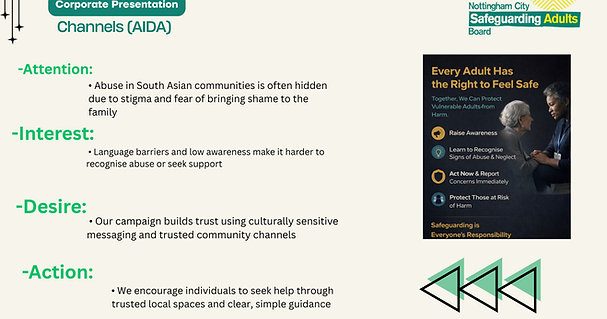
My owned slide(s) | Slide 9 — AIM-INSIGHT-ACTION-IMPACT | Slide 10 — AIDA, Slide 17 — Budget tiers |
Sector | Sport / sponsorship | Public sector / safeguarding |
Audience | Sponsors (B2B) + cricket community | South Asian heritage + English-not-first-language communities |
Client type | Regional sports league seeking sponsors | Statutory safeguarding board seeking reach |
Looking across both the EMWCL and Bloom × NCSAB projects, I noticed that even though the briefs were completely different, I naturally gravitated towards the synthesis and strategy-framework sections in both projects. In the Bloom project, I focused heavily on structuring the campaign logic through frameworks like AIDA and the tiered approach, while in EMWCL I worked on the closing AIM → INSIGHT → ACTION → IMPACT synthesis slide. That pattern made me realise that I am most comfortable working at the stage where different ideas, research, and recommendations need to be connected into one clear strategic direction.
This also helped me understand the type of role I tend to bring to group projects. Rather than focusing only on isolated research tasks, I seem to add the most value when helping shape the overall structure and integration of the final strategy. In future projects, I would approach group work with more awareness of this strength and volunteer earlier for roles involving synthesis, structure, and strategic flow.
8. Outcome and Status
The deck was presented to module stakeholders during Block One. As of writing, no formal outcome has been communicated regarding adoption of the sponsorship strategy by EMWCL — the work stands as a credible, evidenced proposal rather than a confirmed campaign.
The mark of this project's success is therefore not "did Boots sign a deal" — it is whether the recommendation is defensible: every claim in the Strategy Plan slide traces back to a specific piece of research in slides 2-8, the two-tier sponsorship model addresses both visibility (Boots) and equipment access (Gunn & Moore), and the closing line gives any future EMWCL committee a one-sentence rationale they can carry forward. I am confident the deck meets that bar.