Mohammed Lamine Ahmed Chichi
Marketing · Strategy · Social
Safeguarding for Everyone
Campaign Strategy for Underrepresented Communities
Bloom × Impression × Nottingham City Safeguarding Adults Board · Block One · Group 3
PROGRAMME Bloom (Block One, BUSI22000)
PARTNER AGENCY Impression
CLIENT Nottingham City Safeguarding Adults Board (NCSAB)
MY ROLE Strategy & Analytics Lead — AIDA channel-strategy + tiered Budget model
TEAM Group 3 (5 students)
DURATION Block One — 5+ weeks
1. The Brief
The client and the cause
Nottingham City Safeguarding Adults Board (NCSAB) commissioned our team to design an awareness campaign on adult safeguarding — the work of recognising and preventing abuse, neglect and harm to vulnerable adults. The remit: reach communities that NCSAB's existing channels weren't reaching.
Raise awareness of adult safeguarding services among underrepresented communities in Nottingham — specifically South Asian heritage communities and people for whom English is not a first language — and drive measurable engagement with available support.
The numbers behind the brief
-
~15% of Nottingham's population is Asian or Asian British
-
Existing safeguarding communications were predominantly English-only
-
Target areas with highest South Asian density: Hyson Green, St Ann's, Sneinton, Wollaton
Why this brief mattered
This brief mattered because it focused on adult safeguarding and community outreach rather than a typical commercial marketing campaign. The project was connected to a real safeguarding issue where some underrepresented communities were not fully engaging with existing support services, which meant the communication strategy could potentially have a real social impact beyond the university project itself.
It also felt important because the work involved a real client relationship with NCSAB and collaboration with Impression, meaning our ideas were being developed for an organisation that could realistically apply parts of the strategy in practice. The topic required a much higher level of care, sensitivity, and audience understanding than a normal brand campaign because the communication was connected to people's safety, trust, and willingness to seek support.
2. My Approach — Strategy & Analytics Lead
The first workshop with Impression was called "From Brief to Brilliance: How to Master Campaign Briefs" — and it gave us a 7-point framework we used as the spine of the entire project.
The Impression Campaign Brief Checklist
# | BRIEF CRITERION | WHAT WE NEED TO KNOW |
|---|---|---|
7 | Measurement | What measures of success are we using? |
1 | Context | What do we know about adult safeguarding in Nottinghamshire? |
2 | Objectives | What are we trying to achieve? Are they SMART? |
3 | Audience | Who are we targeting? What do we know about them? |
4 | Messaging & Positioning | What are the key messages to land? |
5 | Deliverables & Detail | What is the client expecting and when? |
6 | Budgets | Do we know the budget? |
My specific contribution
I led the strategy and analytics workstream — the parts of the brief framework concerned with how the campaign would actually reach people (criterion 4) and how it would be funded and measured (criteria 6 and 7). Two concrete deliverables in the pitch deck are mine, owned end-to-end:
A. The AIDA Channel Strategy Framework (deck slide 10)
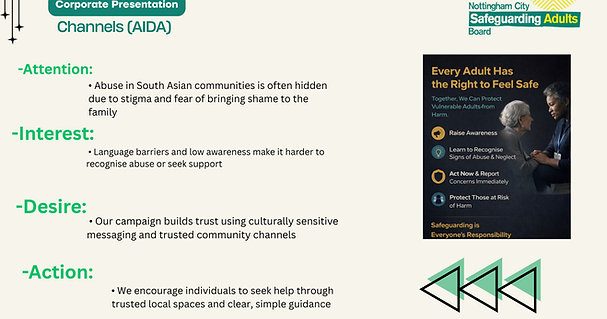
AIDA channel-strategy framework — my deliverable. Each AIDA stage translated into a concrete audience reality for South Asian communities.
I mapped the campaign through the AIDA model — Attention → Interest → Desire → Action — and translated each stage into a concrete audience reality for South Asian communities:
-
Attention: "Abuse in South Asian communities is often hidden due to stigma and fear of bringing shame to the family"
-
Interest: "Language barriers and low awareness make it harder to recognise abuse or seek support"
-
Desire: "Our campaign builds trust using culturally sensitive messaging and trusted community channels"
-
Action: "We encourage individuals to seek help through trusted local spaces and clear, simple guidance"
This framework gave the team a structured rationale for the channel choices that followed — every channel had to do a specific job in the AIDA chain, not just exist.
B. The Tiered Budget Model (deck slide 17)

Bronze / Silver / Gold tiered budget model — my deliverable. Three commissionable investment levels for a public-sector client.
I designed a three-tier budget framework so NCSAB could choose their level of investment based on their funding position:
-
Bronze (£500–£1,000) — organic-only entry point: organic social, basic posters/flyers, small-scale local awareness. Metrics: reach, engagement.
-
Silver (£1,000–£3,000) — mid-tier paid + earned: paid social ads on Facebook/WhatsApp, better content/reels, wider postering, community outreach and partnerships, WhatsApp/social engagement. Metrics: ROI, conversions, audience growth.
-
Gold (£3,000+) — full multi-channel: full digital campaign, professional video content, community events, multi-channel promotion, community leaders/ambassadors. Metrics: ROI, conversions, audience growth.
Tiering the budget made the campaign commissionable — NCSAB could green-light a Bronze run today without needing the full Gold budget — which was important for a public-sector client.
My pitch section
I presented the AIDA channel strategy and the tiered Bronze/Silver/Gold budget model to the NCSAB panel — walking them through why each channel choice mapped to a specific stage of the audience journey, and how they could commission the campaign at any of three investment levels.
3. The Work
Audience research
The team built the audience picture around two facts:
-
~15% of Nottingham's population is Asian or Asian British — a substantial group, concentrated in specific city wards
-
Existing safeguarding communications mostly assumed fluent English — creating a communication mismatch, not just an awareness gap
The Main Challenges identified three barriers feeding the same problem:
-
Unequal awareness — less exposure to official campaigns; signs of abuse not always recognised
-
Language barriers — content "mostly in English only" → harder to understand, less engaging
-
Communication mismatch — target communities lean on word of mouth, family networks, community leaders — not council channels
Safeguarding messages are not accessible or culturally relevant to all communities.
→ The implication the team drew from this: any solution had to be multilingual, culturally sensitive, and routed through community trust — not statutory authority.

Insight / Barriers / Implication framework (deck slide 4) — the strategic spine in one image.
Personas the team built
Ayesha (26)
Barrier: fear of shame / "not serious enough" • Trigger: "Confidential advice — you don't need proof" • Channel: WhatsApp + Facebook community pages.
Imran (38)
"Family matters should stay private." Barrier: distrust + fear of authorities. Trigger: "Support, not blame — practical steps first." Channel: mosques / local shops / Facebook.
Zara (20)
"I'd Google it first." Barrier: info overload, doesn't notice signs. Trigger: 15-second videos, 3 steps + QR. Channel: Instagram / TikTok / uni groups.
Farah (62)
"I don't want problems for my family." Barrier: language + dependency + fear. Trigger: translated info + trusted helper (GP/pharmacy). Channel: GP/pharmacy posters + community centre.
Strategy
Built around three SMART objectives (deck slide 8):
-
Increasing engagement and inclusivity within the community
-
Reducing the stigma behind reporting safeguarding concerns
-
Improving understanding of how to report safeguarding concerns
The strategic direction was community-led distribution over broadcast reach — partnering with the trusted intermediaries each audience already used, rather than running statutory-tone campaigns.

Target Areas map: Hyson Green, St Ann's, Sneinton, Wollaton.
Creative concept: "Safeguarding for Everyone"
The team's creative concept landed on the line "Safeguarding for Everyone — Everyone deserves to feel safe." Four campaign pillars (deck slide 5):
-
To inspire people to speak up about safeguarding
-
To make safeguarding accessible in languages that suit the communities
-
Ensuring knowledge about safeguarding is welcome to all
-
Inclusion within the community
A culturally-resonant Urdu/Hindi line — "GHAR JISA SUKOON" (comfort like home) — appears on the hero mockup, signalling the campaign was designed to live in the target communities' own languages, not just be translated into them.
Tone principles (deck slide 26) — Reassuring, respectful and culturally sensitive, non-judgemental (no blame/shame language), clear and simple, actionable (3 steps + one CTA), accessible (translation option, easy read).

Creative gallery: bus-shelter posters, leaflets, phone mockups.
Channel plan
Offline channels (led by Kate)
-
Places of worship — bulletin boards, community talks
-
Asian supermarkets — high footfall, familiar locations, multilingual reach
-
Punjabi Forest community (founded 2021, 200 members ages 9–82) — safe-space chat, sense of belonging
-
GP surgeries, pharmacies, community centres — leaflet distribution + QR codes
Online channels (my AIDA framework structured the rationale)
-
Facebook community groups — WhatsApp sharing within local networks
-
Short awareness posts, simple visuals, link to safeguarding website
4. Outcome & Reflection on Delivery
No formal outcome (winner / mark / stakeholder verdict) was announced at the point this portfolio went live. This section focuses on what we delivered against the brief, not a competitive result.
What we delivered against the original brief
Mapping our final pitch directly back to the Impression 7-point Brief Checklist:
BRIEF CRITERION | WHAT WE DELIVERED |
|---|---|
Measurement | QR codes + UTM parameters per placement, Google Analytics, social analytics against 3 SMART KPIs (slides 18, 27) |
Budgets | Three-tier Bronze / Silver / Gold framework (slide 17) — my deliverable |
Deliverables | Offline + online tactics with creative mockups; weekly 7-day campaign plan (slides 12–16) |
Messaging | "Safeguarding for Everyone — Everyone deserves to feel safe" + four pillars + DO/DON'T tone guide (slides 5, 26) |
Audience | Geo-targeted (Hyson Green / St Ann's / Sneinton / Wollaton) + four behavioural personas (slides 6–7, 11, 25) |
Objectives | Three SMART objectives — engagement/inclusivity, stigma reduction, reporting understanding (slide 8) |
Context | Situation analysis of safeguarding awareness gaps in Nottingham's South Asian communities (deck slides 2–3) |
In-the-room response on pitch day
Specific in-the-room observations from the formal pitch are not documented here in detail. The substantive measure of how the work landed is therefore the "What we delivered against the original brief" table above — every brief criterion mapped to a concrete artefact in the deck — rather than an after-the-fact recollection. When formal stakeholder or tutor feedback arrives post-submission, this section will be updated on the live site.
5. What I Learned
Marketing skills I built (Strategy & Analytics Lead lens)
Working in the Strategy & Analytics Lead role helped me develop a much stronger understanding of how strategy frameworks can be applied to real audiences rather than only used in theory. Through the AIDA model, I learned how to structure communication differently at each stage of audience engagement and adapt the messaging to the specific cultural context of South Asian communities instead of using generic safeguarding campaigns. This made me think more carefully about how awareness, trust, action, and engagement are built differently across audiences.
I also developed stronger strategic planning and analytical thinking skills by helping create the Bronze, Silver, and Gold budget tiers. That process taught me how to translate campaign ideas into realistic, scalable options that a real client could potentially approve and fund. At the same time, I became more aware of the importance of linking strategy with measurable outcomes, making sure different campaign elements could be tracked through engagement metrics, website traffic, and audience interaction data rather than relying only on creative ideas.
Workplace competencies I built
This project helped me build stronger workplace skills in collaboration, communication, and professionalism while working in a team across multiple workstreams. Because each team member focused on different areas of the strategy, it was important to communicate clearly, share progress regularly, and make sure our sections connected properly into one final presentation. Working on a real client brief also made the project feel more professional and accountable than a normal classroom assignment.
Presenting strategy recommendations and budget ideas to real stakeholders from NCSAB and working within the Impression agency environment helped me become more confident communicating ideas in a professional setting. I also improved my ability to manage deadlines and workload pressure while balancing two concurrent group projects alongside external social media work. The safeguarding focus of the brief additionally taught me the importance of handling sensitive topics carefully and thinking more responsibly about the impact communication can have on different communities.
A moment that challenged me
A specific Bloom-pitch challenge moment is not documented here in detail. Broader challenge-moments from Block One — including the workload of running two concurrent group projects, the pressure of owning closing strategy slides, and pushing past my starting point as a not-naturally-confident speaker through deliberate rehearsal — are reflected on in the Workplace Skills page and the EMWCL Case Study. Those reflections apply directly to the Bloom pitch experience as well.
What I'd do differently
If I worked on the Bloom project again, I would spend more time gathering primary research from people directly connected to the communities we were trying to reach, such as local community leaders or trusted organisations, before finalising the channel strategy. I would also build the measurement and tracking framework earlier in the planning stage so that campaign performance metrics were integrated into the strategy from the beginning rather than added later.
Another improvement would be introducing a stronger peer-review process for final slides and campaign materials, especially for culturally sensitive messaging and presentation details. That would help strengthen both the accuracy of the communication and the professionalism of the final output.
What this taught me about working in marketing
The Bloom project showed me that I am genuinely interested in the strategy and planning side of marketing, especially the stage where research, audience understanding, messaging, and campaign structure all need to connect together. Working on the brief at Impression's office and presenting ideas to real stakeholders made the work feel much closer to the kind of environment I would want to work in professionally after university.
The project also changed how I think about marketing because it showed me that marketing is not only about selling products — it can also be used to support important social and community outcomes. Designing communication for underrepresented communities made me more aware of how much cultural understanding, trust, and sensitivity matter in campaign work. It also reinforced the pattern I noticed across both major projects: I naturally gravitate towards strategy synthesis and building frameworks that connect different parts of a campaign together.
Linking back to the module learning outcomes
-
(a) Core knowledge, skills and competencies required in graduate marketing roles — applied an agency-grade framework, not a textbook exercise.
-
(b) Understanding of the learning opportunities provided by the Marketing Agency Project — the Bloom programme placed me inside a real agency for 5+ weeks.
-
(d) Identifying relevant marketing practices and applying them in a project setting — AIDA model and tiered budgeting, applied to a live NCSAB brief.
-
(f) Capacity to plan, manage projects, achieve goals and work effectively in different contexts — boardroom, agency office, formal pitch venue.
-
(g) Development of technical marketing skills — campaign strategy, budget modelling, channel planning, pitch delivery.
-
(h) Personal skills and competencies for a professional marketing environment — presenting to stakeholders, working in a real agency, defending numbers in Q&A.